Fair Finance Pakistan’s First Policy Assessment of 5 Pakistani Commercial Banks
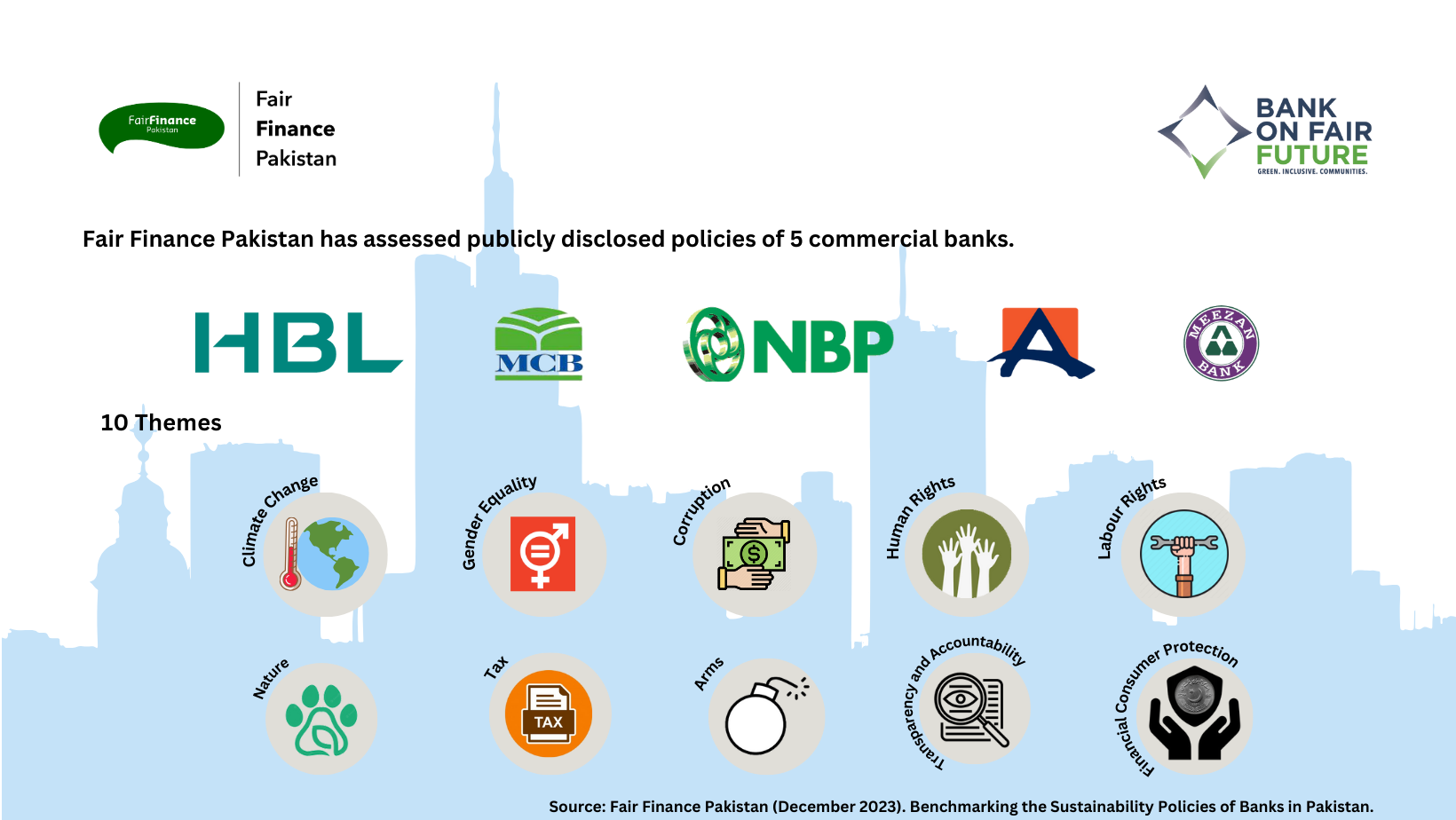
On December 4, 2023, Fair Finance Pakistan (FFP) launched its first ever policy assessment of five top commercial banks in Pakistan with the support of Lahore University of Management Sciences (LUMS) and Profundo.
Titled, Benchmarking the Sustainability Policies of Banks in Pakistan, the policy assessment evaluated Habib Bank Limited, Allied Bank, National Bank of Pakistan, Meezan Bank, and Muslim Commercial Bank across 10 thematic areas in the Fair Finance Guide International (FFGI) Methodology, including climate change, corruption, gender equality, human rights, labor rights, nature, arms, tax, transparency and accountability and financial consumer protection.
The assessment of top five commercial Pakistani banks showed disclosure gaps and low policy commitments on climate change, human rights, gender equality, and labour rights, while none disclose policies on nature and tax when lending money to companies. The highest average scores were for “the themes of financial consumer protection, 4.62 out of 10, corruption, 3.18 out of 10, gender equality, 1.48 out of 10, and transparency and accountability, 1.08 out of 10. For all the other themes, the average score for the five banks is inferior to 1 out of 10, which reveals a lack of public policies on most of the sustainability topics assessed.”
Policy Deficit on Climate Change
On the scale of 0 to 10 with 0 being least desirable and 10 as excelent policies, the five banks scored an average of 0.5 out of 10 for addressing climate change. HBL, Allied, MCB, Meezan and National Bank have not publicly disclosed any climate policies aligned with the Paris Agreement in banks’ lending and investment activities.
Gaps on Labour and Human rights
All five banks scored an average of 0.72 out of 10 in human rights policy ratings. None of the banks disclosed human rights policies related to their investment or financing, and do not align with the UN Guiding Principles on Business and Human Rights. All assessed commercial banks scored less than 1 out of 10 on labour rights policies and lack policy commitments to international labor rights standards or adherence to national laws for worker welfare. None of the assessed five commercial banks have formulated public labor rights expectations for their clients and investee companies. HBL, Meezan bank, Allied Bank, MCB and National bank of Pakistan have zero scores on nature and arms.
Gender equality a low priority
With an average score of 1.48 out of 10, no commercial bank reported measures for equal participation and access to senior positions, with the highest reported representation of women on boards at 12.5%, significantly lower than the global average of 27.1% and falls short of the target of 50% set by SDG 5. None of the banks disclose how they apply a gender lens to their lending and investment activities.
Tax, Transparency & Accountability
The 5 banks assessed demonstrated low policy commitments on tax policies, primarily due to the lack of public disclosure on tax transparency. HBL, MCB, ABL, and Meezan Bank operate globally but have not disclosed any details regarding their profits, revenues, subsidies, or taxes in countries other than Pakistan, where they operate. With an average score of less than 2 out of 10, none of the assessed banks disclosed transparency and accountability practices in the companies they invest in or finance. Risk control and grievance mechanism documentation were lacking in all five commercial banks assessed.
Notable progress in financial consumer protection and anti-corruption policies
The 5 banks scored highest on financial consumer protection (4.6 out of 10), followed by anti-corruption policies (3 out of 10). This suggests the commitment of the banks to fair treatment of and non- discrimination against their customers; however, none of the banks disclose any concrete measures taken towards the fair treatment of customers. All five commercial banks have well-defined policies on disclosing bribery and implementing anti-money laundering measures, but they do not provide any disclosure concerning questions related to the companies they invest in or finance.
The policy assessment revealed while the financial institutions in Pakistan are evolving to meet the Environment, Social and Governance (ESG) criteria, their policies remain silent on the scope and measures to limit ESG related risks based on the international standards defined by the Fair Finance Guide International (FFGI) methodology. Pakistani commercial banks have gaps in content and scope of policy commitments in their internal operations and the companies they invest in or finance.
The policy assessment offers key recommendations to create a more responsible and sustainable financial sector in Pakistan:
Key Recommendations
- Banks must publicly disclose their sustainability policies, investment portfolios, and due diligence protocols for investee companies — a constitutional obligation under Article 19A that empowers every Pakistani depositor to know how their money is being used.
- Banks should be encouraged to adopt comprehensive environmental policies encompassing nature preservation and climate change mitigation.
- Banks should be encouraged to develop and implement gender-sensitive policies that promote diversity, inclusion, and equal opportunities to ensure gender equality.
- In human rights and labor rights, the banks should be advocated to adopt clear policies on human rights and labor rights, including adherence to international standards.
- For financial consumer protection, banks should have clear policies on the fair treatment of their customers and report concrete measures to ensure that customers are not discriminated against.
- For transparency and accountability, banks should be encouraged to enhance transparency in their investments, including the clear documentation of risk control and accountability practices.
- Banks should develop and disclose tax policies that promote transparency and compliance with tax regulations and ensure public disclosure of relevant financial components.
- Banks should support the implementation of anti-corruption measures, including robust anti-bribery and anti-money laundering policies, terrorist financing, and proliferation financing.
- It is strongly recommended that both regulatory authorities and civil society take proactive measures to monitor banks’ operations closely, ensuring genuine compliance and effective policy implementation, with the inaugural assessment serving as a valuable reference.
- Fostering increased collaboration between banks and stakeholders, including regulators and civil society organizations.
More Information:
To read the full report, click here.
International Media report, here.
View results here.